Using AI to Create Smarter, Non-Lethal Adversaries in Games
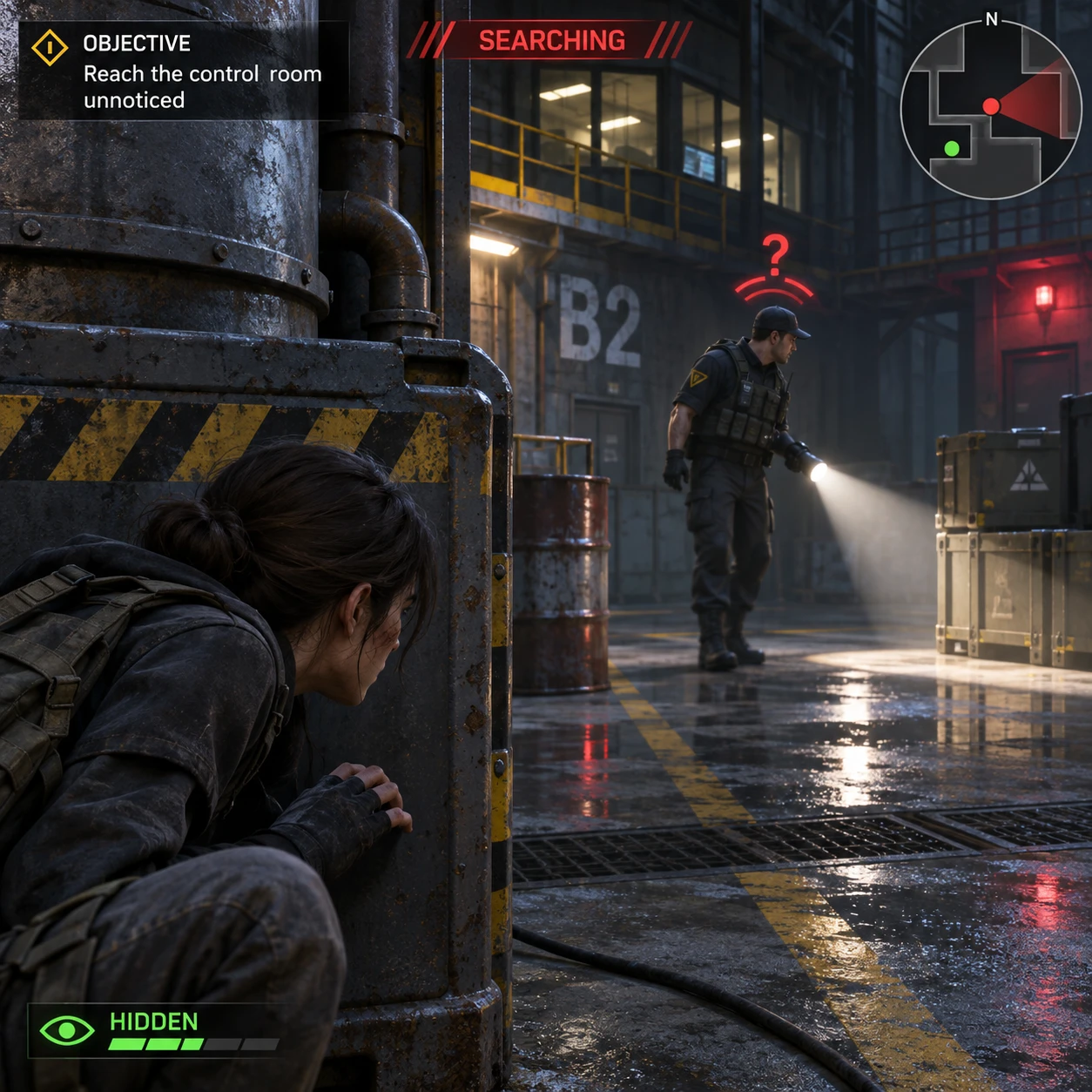
A convincing adversary does not need to defeat the player by killing them. In games, non-lethal adversaries can build tension by spotting, pursuing, cornering, capturing, or forcing the player to change plans. The design challenge is to make those responses feel purposeful and fair, while giving players meaningful ways to act.
That takes more than choosing an AI architecture. Game AI works best when its goals, signals, movement, and consequences all support the encounter design. Here’s a practical way to shape opponents who create pressure without reducing every mistake to a game over.
What Makes an Adversary Smart—and Non-Lethal?
A smart, non-lethal adversary reacts to what the player does and creates stakes other than death. It might raise an alarm, block a route, take an objective, or attempt a capture, giving the player a readable problem and a chance to respond.
“Smart” should describe the quality of the opponent’s decisions, not how aggressively it attacks. A guard who investigates a noise, checks a likely hiding place, then calls for help can feel more credible than one who charges straight at the player. The sequence tells a story: the guard has limited information, forms a hypothesis, and acts on it.
Non-lethal outcomes still need consequences. Capture could cost time, separate the player from equipment, or move them to a new area. An alarm might bring reinforcements or close a shortcut. These costs make player choice matter without making every encounter fatal.
A useful design test is to ask three questions: What does the adversary want? What evidence does it have? What can the player do about its next move? If the answers are clear in play, the behavior is more likely to feel intentional than arbitrary.
Give Enemies Goals Beyond Attacking
Enemies create varied, non-lethal pressure when they pursue specific goals beyond attacking the player. They can warn allies, guard an exit, capture a target, retreat to safety, or call for help, with each goal changing the encounter in a distinct way.
Start with a small set of actions that have clear gameplay effects. For example:
- Warn: A guard signals nearby allies, giving the player a short window to interrupt, hide, or escape.
- Guard: An adversary protects a doorway or device, making the player find another route or create a distraction.
- Capture: An opponent closes distance and attempts a takedown, which the player can evade, interrupt, or resist.
- Retreat: A threatened enemy falls back to a safer position, drawing the player into a different space or buying time.
- Call for help: An adversary triggers a response that changes patrols or raises the alert level.
These goals should fit the character and setting. A cautious sentry may protect an alarm panel; a nervous civilian guard might retreat and shout for backup. Giving every enemy every behavior can blur their identity and create implementation work without adding useful variety. A few distinct roles, supported by reliable animation and sound cues, often produce richer encounters.
Choose an AI Structure That Fits the Design
Behavior trees, finite-state machines, and utility AI can all support non-lethal adversaries; the right choice depends on how many actions an enemy needs and how its decisions should change. No single architecture is best for every game.
Finite-state machines organize an enemy around explicit states such as patrol, investigate, alert, pursue, and retreat. They’re easy to inspect and work well when transitions are few and predictable. As exceptions pile up, however, state graphs can become difficult to maintain.
Behavior trees arrange decisions as nested conditions and actions. A tree might prioritize responding to a nearby threat, then checking a sound, then continuing patrol. This structure can make priorities visible to designers, though a large tree still needs careful organization and debugging.
Utility AI scores available actions against current conditions. An enemy might weigh distance to the player, confidence in a sighting, health, and proximity to allies before choosing to pursue, call for help, or retreat. Utility systems are useful when several responses compete, but poorly tuned scores can cause indecision or behavior that is hard to explain.
Teams can combine approaches. For instance, a finite-state machine can define broad alert levels while a behavior tree or utility system selects actions within each level. Prototype the simplest structure that expresses the design, then add complexity only when playtests reveal a real limitation.
Make Encounters Respond to Player Choices
Responsive encounters use detection, stealth, movement, and player tactics to shape enemy behavior. The opponent should react to evidence it could plausibly perceive, then give the player room to understand and influence what happens next.
Separate detection from certainty. A sound behind a wall might lead an enemy to investigate, while a clear sighting could trigger pursuit. If every small noise instantly reveals the player’s exact location, stealth becomes a test of memorizing invisible rules rather than reading the space.
Navigation and pathfinding matter just as much as decision logic. Enemies need routes that let them approach, search, and retreat without getting stuck or appearing to teleport. Test common player tactics such as climbing, doubling back, using a distraction, or blocking a doorway. A credible adversary can adapt, but it should not magically bypass the level’s physical rules.
Player choice becomes especially meaningful when actions trade one risk for another. The player might silence a guard and avoid an alarm, but spend time doing so; or escape quickly and accept that other enemies will become alert. Counterplay can include breaking line of sight, using cover, creating a decoy, interrupting a call for help, or choosing a route outside a patrol’s reach.
Preserve Fairness and Readability
Fair non-lethal adversaries signal what they know, behave consistently, and offer counterplay before consequences land. Players should be able to connect a sound, sighting, or failed tactic to the enemy’s response.
Use a mix of animation, audio, and environmental feedback. A guard can pause and turn toward a noise before investigating; an ally’s call can be audible before reinforcements arrive. These cues establish cause and effect, helping players learn the system without a tutorial explaining every rule.
Consistency does not mean enemies must be predictable in every detail. It means the underlying rules hold: a guard who investigates noises should do so under comparable conditions, and a capture attempt should have a recognizable wind-up or range. Vary timing and routes for replay value, but avoid changing rules invisibly.
Watch for common design traps:
- Making every mistake trigger a full alarm: This removes room for recovery. Use escalating states, such as suspicion, local alert, and area-wide response.
- Giving enemies perfect information: This makes stealth feel pointless. Limit their knowledge to what they can see, hear, or communicate.
- Adding behaviors without clear cues: Players may read a fair rule as a random penalty. Pair important actions with visible or audible tells.
Non-lethal design does not require gentle opposition. A capture can be stressful, and an alarm can reshape a level. The key is making the consequence understandable and giving players a plausible opportunity to prevent, resist, or recover from it.
Test, Tune, and Iterate
Playtesting reveals whether AI-driven encounters feel readable, challenging, and varied in practice. Observe what players believe the enemies know, what they try in response, and where those assumptions differ from the system’s actual rules.
Test one question at a time. For example: can players tell the difference between an enemy investigating a sound and actively pursuing them? Does a capture attempt leave enough time to react? Can a player recover from a minor mistake without making the encounter trivial?
Record more than completion and failure. Useful observations include how often players are spotted, how long they stay in pursuit, whether they use alternate routes, and how frequently they interrupt an alarm. Pair those measures with direct observation: a high escape rate may look successful, but players could be succeeding through an unintended path or simply failing to notice an enemy.
Run tests with different play styles. A cautious player, a fast-moving player, and someone who experiments with distractions will expose different weaknesses in stealth and detection. Tune perception ranges, reaction delays, pursuit duration, and reinforcement timing one variable at a time where possible. Change too many at once and the team may not know what improved the encounter.
Finally, keep designers and engineers looking at the same problem. A behavior tree can be technically sound while its goals clash with the level’s pacing. AI is part of encounter design, not a substitute for it. When adversary goals, navigation, player choice, and feedback reinforce one another, non-lethal opposition can make a game more tense without making it less fair.